27 September 2006

Girl Scout Mania

After looking through the Junior badge book and the Brownie try-it book, they've come to a decision about which badges to work on: all of them.

Kid1 is doing this in a very methodical way, earmarking 2 or 3 to work on at a time. When finished with those she will move on to others. This isn't the way I would do it ... I would do all of them concurrently. I'd make some sort of spread sheet to show what I've got done on each and every one, and track my infinitesimal progress. Then I'd be all exhausted and discouraged after setting up this massive system, and ditch the whole idea of earning any more badges.

Kid1 didn't inherit that slow-and-steady-wins-the-race gene from me.

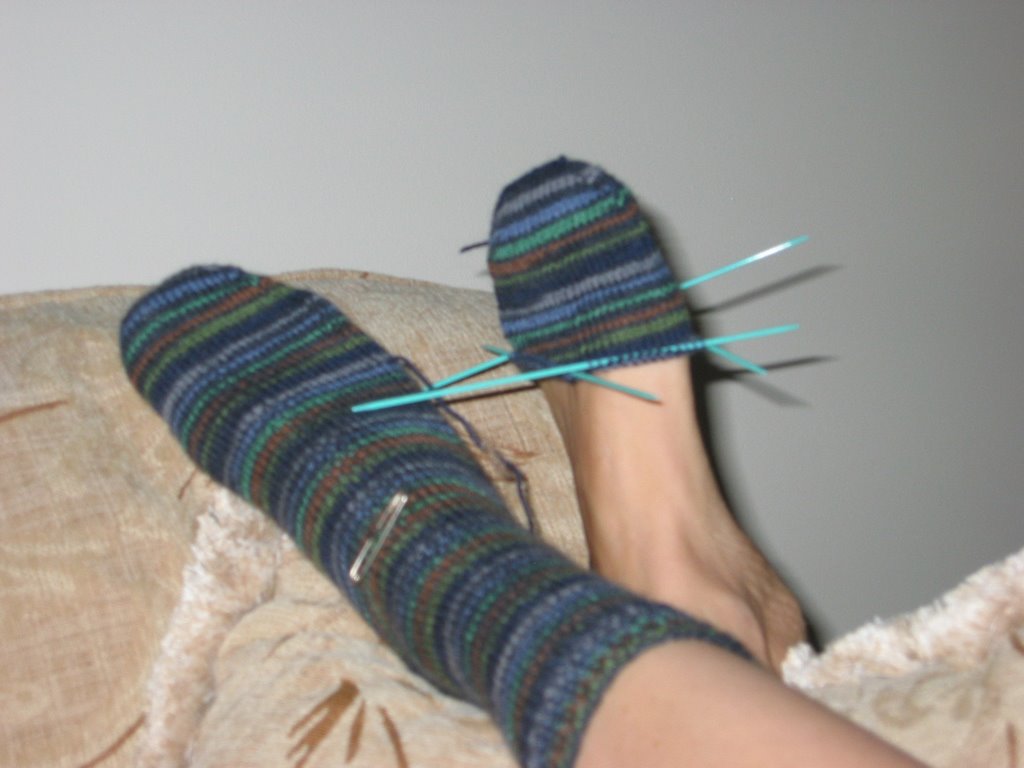
But, check it out, the socks match our current mania -- the stripes have Girl Scout colors of blue, brown, and green:


Knit our of Regia Strato in colorway Orion, which is discontinued. I know it's discontinued because MrV commented that he really liked them and would like to have a pair for himself. I looked the color up, and discovered the grim news that we might not be able to knit a pair for every person in our family ( but if I did knit a pair for MrV or anyone else, I'd do them toe-up so I didn't end up like Poppins and the Regia socks she's knitting for her husband, especially since I don't have relatives in Germany who can bring me more yarn).

We were at Old Navy over the weekend, and discovered socks with the same stripes. So, Regia has already abandoned these stripes, Old Navy and I are just now getting on the bandwagon. What does this tell us?

26 September 2006

RightStart Geometry

The continuing saga of our adventures using RightStart Geometry and RightStart B. I have a 11yo and a 6yo who have average math ability.The 11yo has done Miquon, Singapore, RightStart Transitions, Level D and Level E; RightStart has saved her from a life a math phobia.

On Tuesdays I upload an update of what we did in math for the week.

RightStart Geometry:

Lesson 57 Squares on Right Triangles

Still building up to the Pythagorean Theorem, which Kid1 has heard of before (notably in the book Murderous Maths). The lesson is simple and to the point.

Lesson 58 proofs of the Pythagorean Theorem

Finally, geometry with proofs. The lesson gives some history of the the Pythagorean Theorem (The Egyptians, the Chinese, and Hindu mathematicians knew about it before Pythagoras; James Garfield wrote a proof for it). The lesson also gives a brief explanation of what a proof is. I’ve been casually explaining this to her as we go along. Finally, the lesson highlights “You need to know” pointing to c squared equals a squared plus b squared.

The worksheets involve playing around with congruent figures, stating the theorem in your own words, and working through an informal proof.

Lesson 59 Finding Square Roots

Students learn the square root symbol, review simple square roots (like the square root of 25, say, or 64) and practice doing square roots on a calculator. Some lesson time is given to learning to use the calculator efficiently, something I was never taught to do, because of which I tend to avoid the Memory key. We do not own the calculator sold by the RightStart program; this isn’t a problem, since the directions are pretty generic.

Kid1 whips through this lesson

Lesson 60 More Right Angle Problems

Two pages of worksheets. The first takes over an hour, as I am not available for questions and she has to slowly figure things out on her own (By the way, she seems to have learned the skill of looking at the answer and then working backwards to figure out how she should have done the problem).

Most of the worksheet problems are practical story problems which involve a squared plus b squared equals c squared. One involves fitting skis into a trunk (later, at supper, we discuss that life is never that simple because a trunk isn’t actually a rectangle, and you always have a lip and the hinges to deal with; really, the best way to see if skis will fit in a trunk is to try to fit them in and see what happens). Another involves screen size of a television (although MrV points out that screen size is no longer such a big deal; what matters is whether they’ve put the speakers on the sides or on the top, thereby ruining your chances of ever fitting it onto the shelf).

21 September 2006

Tuesday Teatime


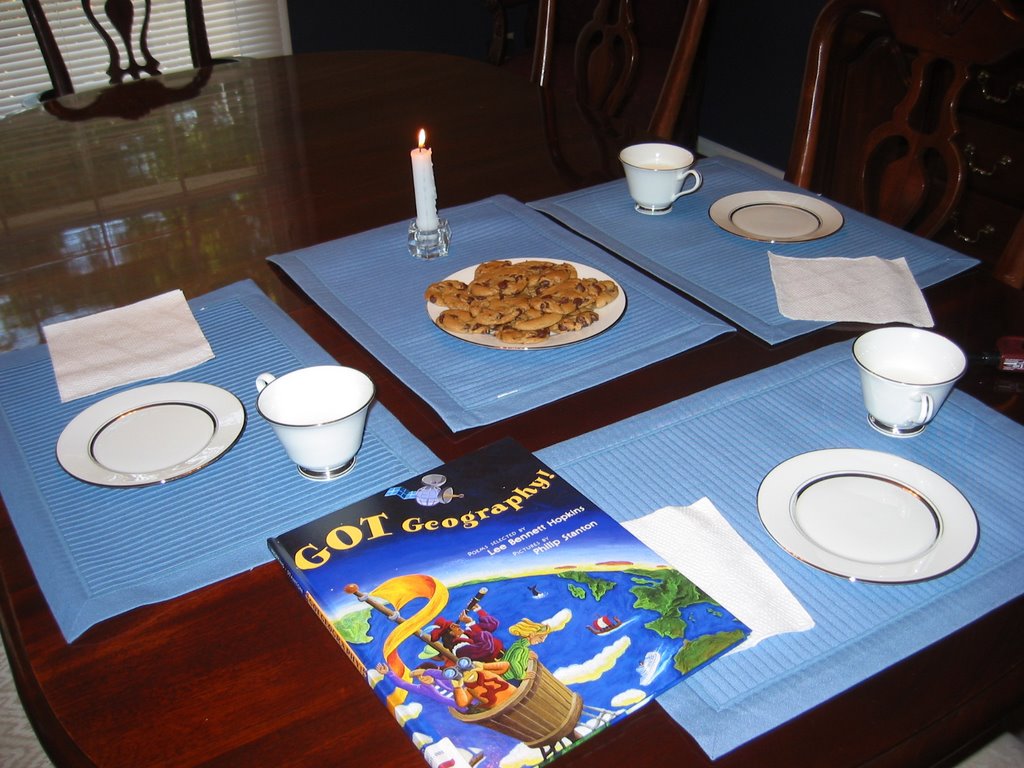
We read all of Got Geography. The poems were great, the collection wasn't too terribly long, and BONUS! it somewhat assuaged that nagging feeling that we don't spend enough time on geography in its many forms.

We dined on slice and bake chocolate chip cookies. The refrigerated dough was on sale this week, plus it was cool enough to turn on the oven to bake. I must admit, though, that the cookies and dough aren't as good as I remember them (yes, I sample the raw dough -- I figure it's pasteurized). But they still smelled wonderful in the oven, and sometimes that's pleasure enough to make up for lack of taste.

And, of course, milk in our china cups. For dunking.

Whew, September hasn't been the best for Teatimes. But this was a nice little break in a busy day within a busy week.

And now, if you'll excuse me, I just got a wonking huge box from Webs . It is time to dump everything else I should be doing, and swatch.

20 September 2006

More Sock Thoughts

I've decided that what I like about toe-up socks is that they require practically no planning. You just cast on some stitches (note to OliveOyl: I was inspired by this sock in Knitty to cast on this way for 18 stitches on 2 double points). You increase until it looks like it will fit around your foot, then knit merrily away. You stick in a heel (I didn't like the heel in the Widdershins sock, as it involved too much thinking, so I used the heel in Wendy's toe-up sock instead, modifying for the number of stitches I was using). Also, you stick a couple of safety pins in to remind you where you put the heel, so you have a clue when you knit the second sock.

Then you just knit as long as you feel like it, and bind off whenever you want to.


How relaxed this all looks, lounging on the big comfy chair! Really, you wouldn't know looking at all this comfy coziness that we're dealing with the ongoing water-heater drama (I have not one, but two new water heaters in my basement right now, neither of which is in that great of condition, both of which probably need to be removed; speaking of which, when you remove these could you please not slosh water -- nasty rusty water, especially -- all over the carpet and gouge holes in the walls, or at least tell me there's a problem instead of leaving me to walk downstairs and discover it myself?), that we're getting ready for a vacation that has morphed into a disaster-on-wheels before we've even packed the car, that we're in the throes of more birthday celebrations than we have people in our family (how did that happen?), that we're trying to do school, repair the driveway, get used to going to dance and choir and swimming (which means I need to have planned menus done hours and hours ahead of time that we can eat as soon as we can get home ... and they need to be gluten free, dairy free, almond/cashew free, pinto/kidney bean free, no trans fats, low saturated fats, no beef or pork as major ingredients, and take into account long time between prep and serving) ....

September is sort of a stressful month around here. Toe-up socks are mindless. It's a good combination.

19 September 2006

RightStart Geometry

The continuing saga of our adventures using RightStart Geometry and RightStart B. I have a 10yo and a 6yo who have average math ability.The 10yo has done Miquon, Singapore, RightStart Transitions, Level D and Level E; RightStart has saved her from a life a math phobia.

On Tuesdays I upload an update of what we did in math for the week.

RightStart Geometry:

Lesson 54 Rectangles Inscribed in a Triangle

In lesson 53 Kid1 was unable to bisect a side of a triangle -- she forgot to draw a perpendicular back up to the line segment she was bisecting. I had showed her how to do it, and wondered whether she had really learned what to do.

The same thing happened in this lesson. This time it was a matter of a quick, “Remember, you go straight up here.” Ah. I think the lesson will sink in more with the repetition. I know I’m getting better at it.

Lesson 55 Connecting Midpoints in a Quadrilateral

Kid1 has a headcold. She stops frequently to get a tissue to wipe her nose. Every time she stops for tissue she tries to sneak a peek at The Sea of Monsters to read just a few more sentences. The lesson is interminable. She is to draw a quadrilateral, find the midpoint of each side, inscribe a new quadrilateral in it, measure the area of each, compare the two areas. This last bit involves using ratios, which clearly still puzzle her. It doesn’t help that her measurements are a wee bit off, giving her a ratio of 18 to 10. I prompt, “What is that a lot like?” Her mind is stopped up with snot. I suggest she stop after the first worksheet. She does.

The next day her head is clear. She knocks off the second worksheet in no time. She comments that it is much easier than she thought it would be.

Lesson 56 Introducing the Pythagorean Theorem

I always wanted to have more Montessori math manipulatives around when the kids were little. I thought it would be cool to play around with some of the Pythagorean stuff.

The lesson involves drawing squares, each using the side of the triangle as one side of the square, then comparing the areas. Easy. Kid1’s unsolicited comment: “This lesson was short and fun.”

14 September 2006

If our socks could talk...

" 'There, that's finished,' Mama said. She stood and held her knitting up to the window. It was a gray stocking for Papa.... A year ago those stockings had been crinkly wool on the back of one of those merinos. Papa had sheared the fleece from the sheep's back, and Mama had washed it and combed it smooth with her spiky-toothed carding brushes. Then she had spun it into yarn on her spinning wheel. And now that yarn had been knitted into a pair of stockings.

"Charlotte looked at these stockings, flat and soft and gray in Mama's hands. It seemed to her they were made of more than just wool. There were words and thoughts knitted into them like the tiny prickles of grass seed that sometimes stayed stuck in the wool even after it had been washed and carded and spun. All the words that had been spoken while Mama's quick hands made the needles cross and uncross around the endless strand of wool -- all those words about the war, and Mr. Madison, and the cannon-heavy ships -- they were all there, knitted into Papa's stockings."
(From Little House by Boston Bay, by Melissa Wiley)

I imagine the stockings in the book looked a little like this.

Reading that passage inspired me to start a pair of sensible socks. I have no sheep, no roving to card, no handspun wool, so I picked a sensible-looking skein from my stash, in this case some Regia:


I think knitting toe-up socks is ever so much more sensible than top-down. Top-down always strikes me as backwards and queer.

In any case, if these socks could talk, I don't know what they'd say about the sheep, or the spinning with polyamide. I imagine the conversation would be in German or Italian, though. The skein travelled through WEBS yarn store, so it was in the same state (Massachusetts) as the stockings in the above passage.

And those green needles? I don't even know where they're from. I got them from my grandma, who got them from another lady at the Assisted Living Facility. They're not even a matched set anymore.

As I knit, the socks are now able to quote from Darmok and Jalad at Tenagra (don't knock it -- that episode features Picard doing an extemporaneous telling of Gilgamesh, and also shows him reading the Homeric hymns in Greek -- a classical ed. goldmine!). They've been to dance class and met a woman who spent $800 on Sonlight curriculum for 2 of her kids this year (she was carrying a very nice Sonlight tote bag; the socks were the conversation starter, but that tote bag got us into the homeschool discussion). They have been to the playground.

Today they will go to swim class. From there, who knows? The world is open.

12 September 2006

RightStart Geometry

The continuing saga of our adventures using RightStart Geometry and RightStart B. I have a 10yo and a 6yo who have average math ability.The 10yo has done Miquon, Singapore, RightStart Transitions, Level D and Level E; RightStart has saved her from a life a math phobia.

On Tuesdays I upload an update of what we did in math for the week.

RightStart Geometry:

Lesson 53 Connecting Midpoints in a Triangle

This ended up being the only math lesson done all week (due to a field trip and then illness). It ended up being a doozy, though.

The worksheet has a triangle on it; the student is supposed to find the midpoint of each side of the triangle, then connect the midpoints. Kid1 quickly found the midpoint of the base, next found the midpoint of one of the legs, then collapsed into tears of frustration trying to find the midpoint of the other leg.

She cried for help (in a very specific way -- the directions to parents say that the student should ask specific questions, not just a general “I don’t get it”). I, of course, have no memory of how to find the midpoint of anything other than just measuring the line and dividing by two. I absent-mindedly roated the T-square around while contemplating how to approach the problem. Kid1 huffily pointed out that the T-square is to remain in the same direction through all the work, and that had been taught in one of the early lessons (subtext: get a clue, Mom). Then I had the brilliant notion to ask her to show me everything she’d done so far.

“Well, I found the midpoint of the base, then of this line....”

“No, show me step by step. Be specific.”

She showed me. Aha, now I sort of remember how to do this. It’s a matter of using the 45 angle, dropping down to a line parallel to the base, make a new triangle, then drawing a line back from the apex of that triangle back to the line you’re bisecting. Kid1 had neglected that last step of going from the apex back up to the line; actually, I wasn’t sure this was exactly how you’re supposed to do it, but it appeared to work.

Next she connected the midpoints. She was supposed to discuss whether lines in the new triangle were parallel to the lines in the outer triangle. “Some lines seem to be parallel; you can check it with your drawing tools.” The book cheerfully prompted, “If you’ve forgotten how, look back to Lesson 33.” We dutifully turn to Lesson 33, and discover that it’s about Area of a Triangle. Huh?

I know there’s some way to use your drawing tools to figure out parallel lines, but my memory of it is as hazy as my memory of how to bisect a line segment. I suggest she eyeball it. Actually, her lines are a bit off due to the imprecision of her work. I suggest she just go with it because it makes sense to me (some sort of distant memory of 10th grade geometry, I guess) plus I peeked at the answer page.

The rest of the lesson went okay -- just a matter of figuring ratios. Well, it went okay once we had a quick review of what ratios are.

11 September 2006

Braced for the onslaught

This week marks the beginning of extracurricular activities -- all of them. This means hours upon hours of sitting and waiting while kids swim, dance and sing.

This is what I've got so far:


Two portable projects -- a Klein bottle hat, and a toe-up sock.

Last year we didn't sign up for any outside classes since we were in the midst of moving. Oh, the glorious freedom of not having to rush to anything at 4pm every single weekday! On the other hand, it was sort of lonely and isolating.

This year we have a modest schedule. Each child has church choir (meets concurrently on Sunday), a dance class, and a swim class. They have also signed up for Scouts, but as Juliettes, which are the independent scouts. This area apparently doesn't have any Interest Groups -- all the troops here are associated with schools. Kid1 used to belong to an awesome Interest Group troop full of homeschoolers.

Kid1: "I don't want to join a troop. They might want to work on different badges then I want to work on. But I still want to sell cookies."

Me: "Ummm. Well. I don't think you can sell cookies if you're a Juliette." (Exit to scream and jump with excitement at the prospect of No Cookie Sales.)

Kid2: "I don't think this is fair. I should have a chance to join a troop. I never got to belong to a troop."

Kid1: "Oh, for pete's sake. The meetings are boring. You wouldn't like them anyway."

Which is true. Kid2 likes the concept of being around other kids, but often finds the reality of the other kids downright annoying. I think she is a Highly Sensitive Child. Or maybe she's just a control freak. In any event, three programs a week is plenty for her to deal with.

08 September 2006

That feeling you get when you finish a great book in the middle of the night, and want to tell someone about it

I got a copy of Rick Riordan's The Lightning Thief yesterday. On a whim, I started reading it after the kids went to bed.

I finished it at 2a.m. Y'all gotta know, I never stay up after 10p.m. Never. But, well, I kept thinking that in a few more pages I'd get to a good stopping point....

No, that's a lie. It was pretty apparent early on that this book was non-stop.

I'd love to write the witty, wonderful review this book deserves, but I'm operating on way too little sleep. Let's just say that I wanted to bounce into Kid1's bedroom as soon as I finished the book, wake her up and tell her about it. That's how excited I was.

Greek gods! Olympus! Hades! New York! Las Vegas! Los Angeles! A quest! Characters swearing at each other in ancient Greek, and the occasional Latin! General goofiiness!

Wafting around the internet this morning, I see that people are drawing comparisons to Harry Potter. Pshaw. I'd compare it more to Terry Pratchett's DiscWorld.

You need to go read it. Really. It's vital to your classical education.

05 September 2006

RightStart Geometry

The continuing saga of our adventures using RightStart Geometry and RightStart B. I have a 10yo and a 6yo who have average math ability.The 10yo has done Miquon, Singapore, RightStart Transitions, Level D and Level E; RightStart has saved her from a life a math phobia.

On Tuesdays I upload an update of what we did in math for the week.

RightStart Geometry:

Lesson 49 Other Congruent Triangles (SAS, ASA)

The Student is to start off by doing 4 problems on the worksheet, then reading the lesson, then finishing the worksheet. The final problem makes use of the recent lessons on transversals and alternate angles (lesson 47). Kid1 gets a different answer for the last problem then that shown in the book. We look it over together, discuss why various answers may be true. I tell her that she will eventually be able to write up this discussion as a “proof”. I mean to email Dr. Cotter and ask if the answer sheet should list the alternate answers, but forget about it in the hurleyburley of life.

Lesson 50 Side and Angle Relationships in Triangles

Read about half the lesson, do the worksheet, then finish reading the lesson. The student should’ve discovered the relationship between angles and sides while doing the worksheet. I like this set up. It’s a nice change from the “we’re going to tell you about it, then you go drudge through a bunch of problems practicing what we just told you.”

Lesson 51 Median in Triangles

Major typo on this page. First there is a picture captioned “Line segments ME, DI, and AN are medians.” Then there is a blank space captioned “Line segments AR, EN, and OT are not medians.” Well, yes, given that AR, EN, and OT don’t exist, they certainly aren’t medians. But we can only speculate what other non-medians might look like.

On the worksheept the student is to draw a trinagle and construct medians, then compare answers with classmates. Sigh. Not only do we have nonexistent medians, we have nonexistent clasmates.

Lesson 52 More About Medians in Triangles

This lesson is one of those “1 or 2 days” types of lessons. Kid1 doesn’t notice this designation, and struggles through the entire thing in one day. It starts off with a materials list that requires a pencil with a new eraser, a craft stick (we cannot find any of the dozens we swear we have, and consider eating popsicles to liberate some more; in the end, she uses a pencil with flat sides). The odd materials are used to try balancing triangles on various points and lines -- a triangle can balance on a meridian, and also on its centroid point.

The worksheets require much measurement. She is to find areas of various triangles. She has forgotten how to find the area of a triangle. She is wailing and gnashing teeth. I remind her, “Remember that thing with the parallelograms?” That’s enough to remind her of one way she had derived the method for finding area of a triangle (frankly, I couldn’t remember the formula either after a 20 year lull in my need to know it; the parallelogram example is how I derive it).

But, oh, the anguish ... many of her measurements are a wee bit off from the measurements used in the book. I remember this sort of thing happening with earlier levels of RightStart -- we would often find ourselves a bit off, a millimeter here or there, from the book’s measures. So frustrating. I look at her worksheet, look at the answers, say, “Look, do you understand the point they’re trying to make? Okay, then. That’s what’s important.”

(For the record, she usually checks her own answers. This turned into a tandem math lesson, though.)

31 August 2006

Picovoli and other disappointing things

Pattern here.


Debbie Bliss Cathay, size 4 needles, knit in size 32.

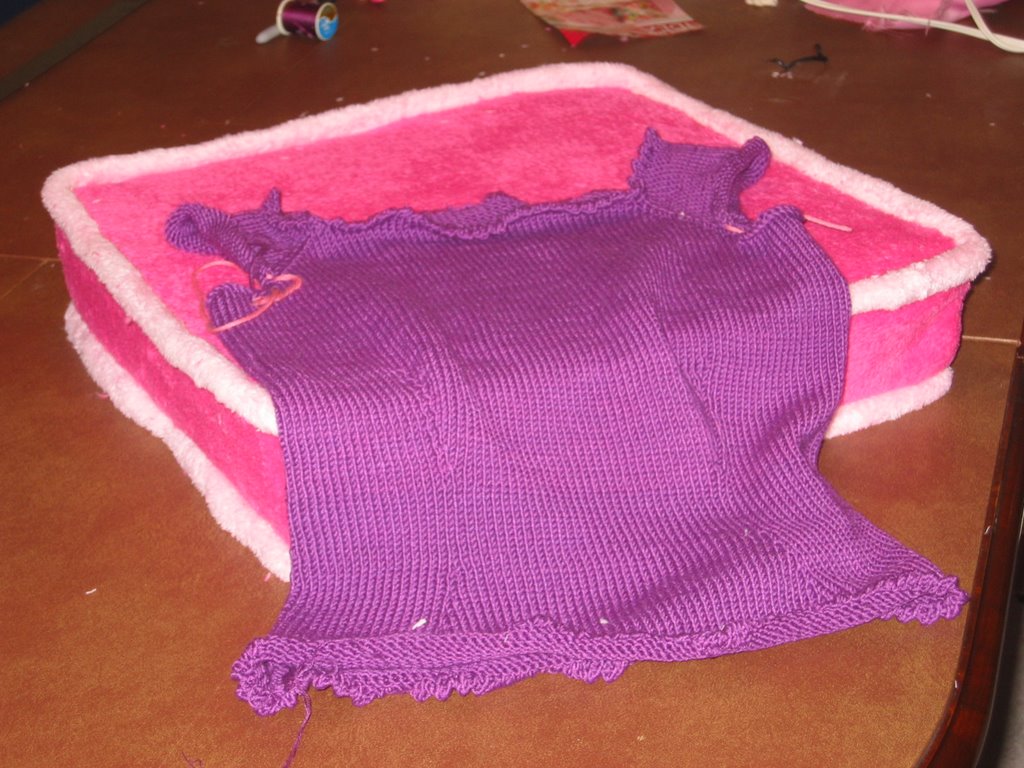
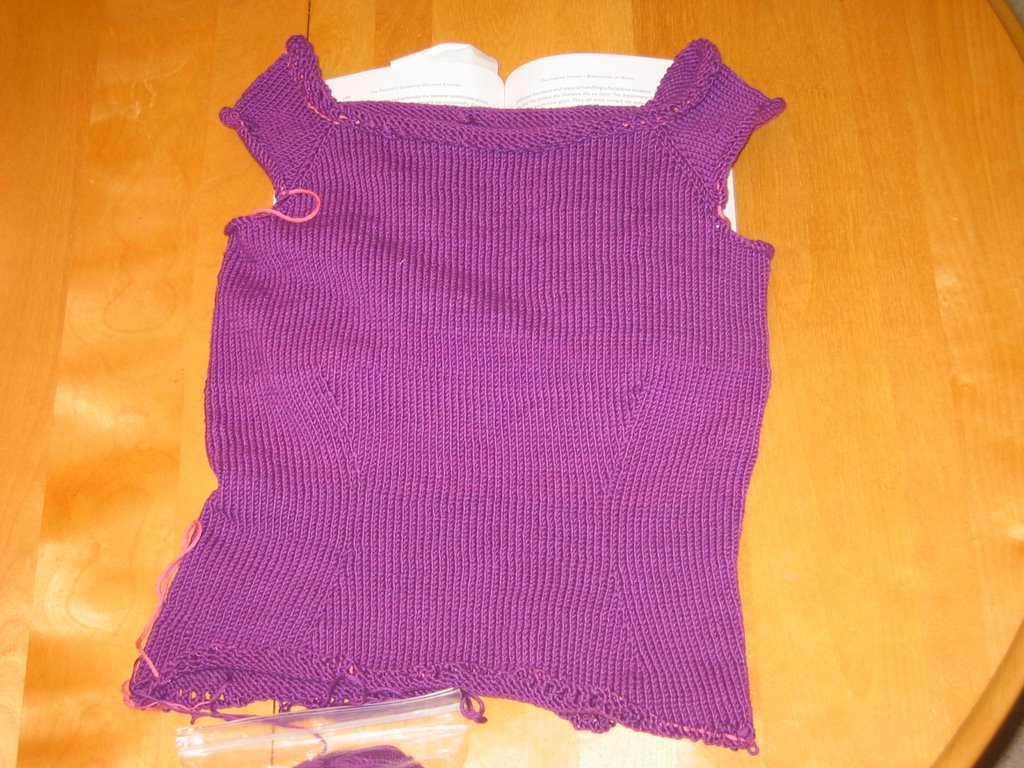
My impressions? Eh. I like the shaping. The picots ... the picots are annoying. They're made by yarn overs/knit 2 together for a row, then 2 rows of stockinette stitch, then folding along the yo/k2tog row and sew down the live stitches. This makes for a bulky picot. Also, check out how this top hugs that flab roll on my back. Yikes, I didn't know I had a flab roll there!

Overall, I didn't feel like this item deserved more effort in the picture-taking department, because I'm wallowing in disappointment right now.

I blocked it by immersing in water, rolling up in a towel to blot excess water, then laying out on another towel. The Cathay bled a periwinkly outline on the towel I laid it on. The blocking helped the picots, but they still need to be beaten in submission with an iron or something. I suspect that it will take another session with the iron after every wash. Bleh.

Someday I might unsew the edges, unravel the picots, and put a smoother edge on it. Sheesh, sounds like a lot of work.


Other disappointments:

We just finished reading Charlotte's Web. Charlotte died, once again. We all sat on the couch, bawling. Do you know how many times I've read that book? How many times I've heard it? My mom used to read it to me when I was little. We cried every time Charlotte died. I don't know how many times she read it to me, but I felt like I had nearly memorized it by the time the fateful day came that I picked it up on my own (we owned a hardback copy). I had been working on those uber-boring reading exercises in school, probably first grade, and just happened to pick it up ... opened it ... and started reading. "Where's Papa going with that ax?" Oh my gosh, I was Reading. Reading a Chapter Book! On My Own! It was one of the most exciting moments of elementary school. And catapulted the book to the category of Sacred Text in my mind.

These days we have it as a book on tape read by the author. He does an excellent job, and never starts sobbing inconsolably when Charlotte dies. The kids have listened to it about a billion times. You'd think we'd be hardened to it by now. But, no, I got out the hardback from the library to read to the kids because it's the August selection in The Arrow, from whence I get our copywork and dictation selections. The kids had never seen the pictures! Amazing! But, you know, I had never read it aloud to them.

Another disappointment is our water heater. It was installed in 1980. It's feeling its age, rather like Charlotte did there at the end when she couldn't climb down to go back to Zuckerman's farm. It's so old that the parts aren't made for it anymore. It's so huge that it's going to be a massive PITB to get it out of the basement if we need to replace it. Sigh.

29 August 2006

RightStart Geometry

The continuing saga of our adventures using RightStart Geometry and RightStart B. I have a 10yo and a 6yo who have average math ability.The 10yo has done Miquon, Singapore, RightStart Transitions, Level D and Level E; RightStart has saved her from a life a math phobia.

On Tuesdays I upload an update of what we did in math for the week.

RightStart Geometry:

Lesson 44 Measure of the Angles in a Polygon

Now that the student understand the idea of supplementary angles, she can start applying that knowledge to polygons. Well, theoretically she should be able to do this. In reality, the student is a bit surprised that she’s actually doing something with all that rigamorole about supplementary angles from the last lesson.

My personal favorite part of the lesson is the paragraph that begins with bold type: “A tough question” and goes on to say, “You can skip this paragraph if you aren’t curious or already know why you can’t divide the quadrilateral into three triangles.” I think it’s daring and wonderful to tell kids they can skip parts of the math book, and customize what they learn.

The worksheet instructions casually mention that “there is a little algebra.” Hey, no big deal. By now the student-reader realizes that “algebra” isn’t something to worry about.

Lesson 45 Classifying Triangle by Sides and Angles

After a review of equilateral, isosceles, scalene, acute, right and obtuse triangles, it’s time to play little math games. You’re given measures of some angles of the triangle, and need to find the rest. I think stuff like this is fun. Kid1 doesn’t immediately catch on to how it’s done, but eventually gets into the swing of it.

She claims she doesn’t know what complementary angles are. I point out the definition back in lesson 43 (the front of the book lists when all vocabulary is introduced, so it’s easy to look up).

Lesson 46 External Angles of a Triangle

More fun figuring out angles, adding up to and subtracting from 180 in your head. Remeber in earlier years of math when that was a big deal -- adding and aubtracting 3 digits in your head? Now you barely notice you’re doing it, you’re so swept away by the fascinating angles.

Kid1 thinks she’s found an error in the book. When we look at it together we discover the book is correct.

Lesson 47 Angles Formed With Parallel Lines

“Mommy, this book makes angles so much more fun than any other math book!”

Take that curriculum review for what it’s worth -- she hasn’t seen that many other math books, particularly any that have much to do with angles. Today’s lesson is all about corresponding, interior, exterior, and alternate angles, as well as what a transversal is. The tone is light and fun.

Lesson 48 Triangles with Congruent Sides (SSS)

“Here you get a chance to use those inequalities you have been writing since first grade.” Yep, it’s time to use the greater-than less-than signs. The student cuts out strips of paper, then plays around with them to see what triangles can be formed. I happen to be working nearby, so have an opportunity to discuss that sometimes it seems other triangles can be formed because the strips she’s using are actually rectangles instead of lines.

My favorite line in the book: “You don’t have to memorize this, just think about what happens when you try to make a triangle.” Once again, RightStart emphasizes understanding a concept over memorizing it.

23 August 2006

Tuesday Teatime

Tuesday Teatime was held outside in our play fort. We grabbed popsicles and a book of poetry, climbed up, hunkered down, and read.

Our book was Cynthia Rylant's Boris. Boris is a cat, and cats are always popular subjects for poetry at our house. Cynthia Rylant has written an entire book of free verse about Boris and her relationship to him.

Several of the poems were above 6 year old Kid2's head. When we read about Boris in the vet's office swaggering out "with the latest copy of Cat Fancy in one paw and a martini in the other," she wasn't quite sure what was being described. "Is that a kind of doggy treat?" she asked. No, honey, it's a drink, a human drink, and don't worry if you don't quite understand - it's a little old for you. The point today is to enjoy the parts you do understand, and also see that people write poetry about everything, simply everything. And there are many silly, enjoyable-by-a-6-year-old moments in the book.

Kid1, at the sage old age of 10, declared that she really "got" the imagery. Hmmm, I wonder. I silently mused that good poetry (and prose) tells us something new year after year as we grow older. For now, though, it's okay to enjoy the bits and pieces we understand, sitting in a fort high above the ground with lemon popsicles in hand.

22 August 2006

RightStart Geometry

The continuing saga of our adventures using RightStart Geometry and RightStart B. I have a 10yo and a 6yo who have average math ability.The 10yo has done Miquon, Singapore, RightStart Transitions, Level D and Level E; RightStart has saved her from a life a math phobia.

On Tuesdays I upload an update of what we did in math for the week.

RightStart Geometry:

Lesson 40 Area of Octagons.

Lesson 39, area of hexagons, took a long, long time -- over an hour. Lesson 40, area of octagons takes minutes. The student is simply to demonstrate ways it can be done -- no actual measuring takes place. It’s a fun lesson, stretching the imagination as Kid1 tries to come up with various ways to divide an octagon into triangles and rectangles.

Lesson 41 Ratios of Areas.

This gets off to a rocky start, as Kid1 is to draw a rectangle the same height as the one given, but twice the area. I pause to demonstrate how I would do it, a skill honed through years of laziness (“I would just take my T-square and draw a long line here ... and here ... see, I don’t even measure, I just use the lines they used for the top and bottom of their rectangle as my guide ... okay, now you’re ready to figure out how to make the area twice as large”).

I notice she has learned that tick marks can denote equivalent lines. Cool.

Lesson 42 Measuring Angles.

Kid1 is measuring the angle of her elbow with the goniometer. “This book is a lot less stuffy than a lot of textbooks, Mom.” Later she is flipping the goniometer around carelessly. I ask her to stop, not wanting her to ruin it. She replies that the book tells how to put it back together if it breaks. Yeah, well, it’s still not a good idea.

Lesson 43 Supplementary and Vertical Angles

Kid1 come bouncing into the room: “I thought this was going to be a long, boring hard lesson, and I was going to have to ask you for help, but it wasn’t. It was really good.“

“So, was it good because it was easy, or short, or what?”

“It wasn’t exactly easy ... it was just really fun. It wasn’t the most fun of any lesson -- I liked the lesson that was 2 worksheets where you had to name figures better.”

She shows me the worksheet. “Look, here I had to figure out this angle without measuring.” The picture shows various lines which would add up to 360 degrees; I can see that you could easily figure it out using the idea of supplementary angles. “My explanation of how I did it was a little different than their’s. I didn’t understand that I was supposed to write it out step by step as I went through it.” Yes, the students are supposed to be writing out how they arrive at some of their answers. And, yes, this one sounds like an informal proof.

I comment, “Someday you’ll learn to do this in a formal way ... it’s called a ‘proof’. You’ll prove that this angle is a certain measurement.”

She softly sighs, “Oooh,” her eyes shining with anticipation.

21 August 2006

Sewing

Sewing Project 1: Sewing down the picots on Picovoli.

Oh, those picots. So many little picots. All those little live stitches in need of sewing down.

I've separated the Debbie Bliss Cathay into plies, and am sewing with about 3 plies at a time. I'm starting to get the hang of it; I started with the bottom hem, which came out sort of lumpy, and then did the neckline. Both areas stick out (the hem looks like a miniature tutu). I hope blocking will take care of that. I still need to do the armholes.

I still love the shaping on Picovoli -- those lovely princess darts in the front and back thrill me.


Sewing Project 2: Making hot pink fuzzy cushions with pale pink cording.

Since MrV was away doing Guy Stuff all weekend, we did Girl Stuff here. This included trashing the dining room by cutting out and sewing fuzzy, fleecy hot pink knitted fabric for cushions for the top of Kid2's toybox. The raw edge of the fabric drops fuzz everywhere; the fuzz clings to everything it touches. Kid1 said it looked like we'd had a pink snowstorm strike our house. I'm sure it will clog my vacuum cleaner.

The fabric was a horrible choice for sewing cushions -- it crept and crawled all over the place. It was quite stretchy -- a 60 inch strip I cut to encase cording would suddenly blossom into a 68 inch strip. Yikes.

So far I've only completed one of the two needed cushions. The seams are wobbly. The cording is crooked. I swear it is a different shape than the 15 by 17 rectangle I carefully measured out. But Kid2 is enchanted. Hot pink! Fuzz and fluff! It just screams "this belongs with Hello Kitty decor!"

18 August 2006

Tuesday Teatime

This week's menu: Banana "ice cream" topped with fresh raspberries, with strawberry-kiwi juice to drink. (To make banana ice cream, peel and freeze chunks of bananas. When frozen, grind in Champion Juicer fitted with blank plate.)

We read Celia Thaxter's poem entitled August, and also Leisure by William H. Davies. Both can be found in Favorite Poems Old and New.

After that, we went with a back-to-school theme, since the local public schools started up this week. Favorite Poems Old and New supplied School-Bell by Eleanor Farjeon. Then I read selected poems from "Wahoo! Elementary" by Hudson Harrison. Honestly, I wasn't that thrilled with some of the poems in this book. I didn't feel a deep need to read a poem about head lice, for example (at least not today -- let's not rule it out forever). Kid1 had alread read the book to herself earlier in the week, so we discussed our thoughts on the various poems as we went along.

We finished with our traditional taking-turns-blowing-out-the-candle. This week we managed to make it through this without wax splattered across the tablecloth. Woohoo! Just goes to show that practice makes perfect.

15 August 2006

RightStart Geometry

The continuing saga of our adventures using RightStart Geometry and RightStart B. I have a 10yo and a 6yo who have average math ability.The 10yo has done Miquon, Singapore, RightStart Transitions, Level D and Level E; RightStart has saved her from a life a math phobia.

On Tuesdays I upload an update of what we did in math for the week.

RightStart Geometry:

Lesson 35 Converting Inches to Centimeters. I noticed a sidebar on this lesson that gave a mnemonic for the conversion: 1 inch = 2.54 cm is like $1 is 25(quarter) times 4. Hmmm, how clever. I memorized the conversion through brute memorization of using it so often, although I typically use 1 inch equals 2.5 cm when I’m in a hurry (a 4 inch by 4 inch swatch of knitting is the same as a 10 cm by 10 cm swatch, as knitters all over the US are well aware).

After Kid1 completes the lesson I ask if if she remembers the conversion factor. She says, “yeah, it’s 2.75 ... wait, that’s not right ... .” “Wrong number of quarters, I think.” “Yeah, I knew it was something to do with quarters.” I start to pontificate that it’s better to remember it in regards to knitting swatches, and am about to start in on converting seam allowances in home sewing, but she wanders off.

Overall, though, I think maybe the the straight forward memorization is better than the mnemonic. I think she’ll eventually remember it the way I do, through extensive use in sewing and knitting.

Lesson 36 Name that Figure. Fun little game of naming figures which introduces the practice of using letters to indicate vertices. Also has a clever way to remember how to spell Isosceles. Sometimes she simply can’t remember the names of these figures. I worry about that -- does this mean she doesn’t “get” geometry?

Lesson 37 Finding the Areas of More Triangles. The worksheet includes the Guyana Flag problem, which was also in Level E. For some reason we did not do that lesson in Level E, so Kid1 is stymied ... she is trying to measure the sides of the flag in millimeters, and figure out the conversion ratio to give her the measurements given on the worksheet. I point out that she has everything she needs to know without measuring -- the worksheet says the left side is 26cm, the upper edge is 33.8cm, and point E is the center of the flag; we should assume it’s a perfect rectangle.

“Oh!” she exclaims, “that means these 4 triangles have the same area!” Ummmm, does it? I’m not sure off the top of my head, so I cover my confusion by pointing out that we know half the side will be 13cm, etc. etc. so we can find the area of all these other triangles.

As she gets to work I pull out Level E and flip to the lesson. I notice a sidebar: “A gifted child might notice that the triangles each take up 1/4 the rectangle.”

“Hey, guess what! According to this you’re gifted!” Ho ho ho, we laugh. After all, Kid1 is thoroughly convinced she stinks at math ... at least she was until we got involved in RightStart. I guess my worries yesterday were a bit unfounded -- some stuff she’s really good at, some stuff she still needs to work on.

Lesson 39 Area of Trapezoids. First problem; we also didn’t do the Level E lesson on distributive property. Although the geometry book explains it well, I give her a quick rundown (“Pretend I have the invecta balance here and I’m hanging those weights on it....”) and assure her that kids who never saw Level E or any RightStart whatsoever can figure this out. She runs into problems with the worksheet. The book has shown one reason the area of a trapezoid can be expressed as w1 plus w2 times h over 2. She is supposed to discover and explain another way of understanding it: 2 identical trapezoids, rotated and shoved together, make a parallelogram; if you find the area of the parallelogram and divide it in 2, you have the same formula.

She looks frustrated by the concept -- what the heck does the book want? What are they getting at? I say something to the effect, “they just want you to say that since you have 2 identical trapezoids of course you can divide the answer in half. I think maybe it’s so obvious you don’t understand why you have to say it. It’s that ‘gifted child’ thing from yesterday, you know.” She giggles, the mood lightens, and she continues with the lesson.

Lesson 39 Area of Hexagons. She starts off commenting, “you know what? There was another worksheet in the last lesson I didn’t do.” “Are you going to do it now?” “No, I don’t think so.” Thank goodness, because this lesson took at least 1.5 hours as it was. Of course, within that time we ran into a whoppin’ huge fight on the definition of a trapezoid -- for some reason she had concluded that an isosceles trapezoid wasn’t actually a trapezoid, possibly because all the trapezoids she’s been working with are non-isosceles. Thankfully, I found one pictured in lesson 36 (under the lesson on how to spell “isosceles”). Also, she’s quite peeved that 1.2 times 1.4 doesn’t equal something bigger than 1.68 ... pesky decimals.

The final problem involves measuring stars that she had drawn in earlier lessons. I’m glad I’m on hand to demonstrate that you round off the measurements quite a bit to get the ratios needed.

10 August 2006

Knitting Notes

How's Picovoli going, you ask?


Fa bene. Tres bon. Muy bien, gracias.

(I just realized I have no idea how to say "very good" in Latin or Mandarin. How embarassing.)

I love the darts. I don't think you can see them in this photo, but the waist nips in, then back out via decreases and increases. They look like the darts on June Cleaver's dress bodice. I love the effect. Then again, I'd like to prance around my house in those oh-so-structured dresses and high heels, with my hair done. (I just got in from mowing the lawn. I am sweaty and skanky. I never, ever saw June Cleaver look how I feel right now. But this is the only time I can grab the computer between Kid1's work on Rosetta Stone and her typing program.)

I loved all the stockinette. I enjoy stockinette, particularly on circular needles, because I can read while I knit. I have a huge pile of lovely, lovely books from the library right now. Picovoli is reposing on one now -- it's an Interlibrary Loan, with huge notices of NOT RENEWABLE all over it. (This, of course, simply means that my local library doesn't want to mess with renewal requests. I used to be in charge of ILL at a university library. Most lending libraries will grant at least one extension.) So, I must get this book read NOW. This has been a great knitting projecct under the circumstnaces.

Unfortunately, I'm now faced with sewing up all those picots. I don't think I can do that and read at the same time. I shall have to turn to watching television. Fortunately, we just discovered that we have access to 7 hours of Star Trek every week day -- 2 hours of Deep Space Nine, 5 hours of Next Generation. (Classic Star Trek is available on Saturdays.) So there's hope.

Overall, though, I'd rather read and knit than watch TV and knit. I used to knit in my college classes. Being a goody-two-shoes, I always checked with the professor first to make sure it was okay. This was back before knitting was trendy, so it was some weird, bohemian thing I was asking. And, hey, it kept me awake in class. I should've tried it in Soil Science, which had the very poor schedule placement of right-after-lunch. I mean, it's not like I consider Soil Science scintillating to begin with (there are those who do, I know). And right-after-lunch was the death knell. I always sat right in front, in hopes that would help me stay awake. Nope. Zzzzzz. Too bad, because now I'm not sure what to do with the clay soil on the front slope of our yard. (My mind wanders a lot when I mow. Consider a sampling of what it's like to be in my head whilst I'm pushing my mower, which, by the way, is not self-propelled. And have I mentioned how hot and humid it is today?)

The other BIG knitting news was reported to me yesterday afternoon by a very excited 6 year old ... the next American Girl movie will be about Molly. Now, Felicity and Samantha undoubtably knew how to knit, but Molly actually had a story line about knitting in one of her books. As I recall (amazingly, we own no Molly books) the girls in her class at school were trying to knit socks for the (WWII) soldiers. Molly sensed this would be a Bad Idea, probably because she didn't want to turn the heels (coward). So, they turned their knitting into a patchwork afghan. I've always wondered about this -- how can the cuff of a sock become an afghan square? Did girls back then typically work socks flat, then sew them up? Did they fearlessly cut them open? If they could do that, why couldn't they turn a heel? Was the author just sort of clueless about knitting? I need to re-read the book -- maybe I'm remembering this wrong. I'll definitely be watching the movie, though. We might get some kid-sock-knitting action going, or maybe some afghan-square-knitting action.

09 August 2006

Tuesday Teatime

For a total change of pace, we used suppertime as Tuesday Teatime.

MrV was out of town, so we had the supper table to ourselves. I pulled out a copy of Shel Silverstein's Where the Sidewalk Ends. Many of those poems have to do with eating, such as Hungry Mungry, and Pancakes. We also read some non-food poems, like Afraid of the Dark.

I would read a poem, then pause to eat while we would discuss what I'd read. Often the discussion took the form of giggling and repeating favorite lines. Long after the meal was over I overheard lines and images repeated. On the other hand, some of the poems seemed to make no impression at all. That was okay with me -- I didn't like all of them either.

08 August 2006

RightStart Geometry

The continuing saga of our adventures using RightStart Geometry and RightStart B. I have a 10yo and a 6yo who have average math ability.The 10yo has done Miquon, Singapore, RightStart Transitions, Level D and Level E; RightStart has saved her from a life a math phobia.

On Tuesdays I upload an update of what we did in math for the week.

RightStart Geometry:

Lesson 29, Area of Consecutive Squares. Attention please: this is a very bad place to take a break of several months! Really! Lesson 28 goes with lesson 29! If you take a couple of months off, it can get really weird, particularly if your student has issues with the concept presented anyway.

In our house tears soon welled up. She moaned, “I don’t understand this equation!” Pointing to w squared plus 2w plus 1, she read, “width squared plus 2 width plus 1.” I suggested that she read the w as “whatever number you want” instead of “width” -- does that help? Yes, for some reason it does. Or maybe it’s just getting a grip and realizing that yes, she will do this math and survive.

The question at the end of worksheet 29-2, “on what worksheet did you work with that relationship?” is tough, considering it has been several weeks since she did ANY worksheets. I give prompts.

Lesson 30 Perimeter Formula for Rectangles. In this case w is width. She likes perimeter, and would rather do it than area.

Lesson 31 Area of a Parallelogram. While working on the worksheet she calls out to me, “what are factors?” I walk in and glance at her paper, discussing that factors are the things that are multiplied to make a number. The question says that the preceding problems should’ve reminded her of factors. Hmm, that’s odd -- how would the perimeters that’s she’s been doing remind her of factors? But I have something else on my mind, and wander off. She complains that she got the next question wrong. I look at the sheet and, AHA! This was all about area, not perimeter! Egads! I brood because my child can’t remember the difference between perimeter vs. area. Overall, this lesson took an hour and a half, including discussion about whether to erase incorrectly drawn rectangles (based on perimeter) or throw the whole thing out and start over.

Lesson 32 Comparing Calculated Areas of Parallelograms.. Piece of cake. It’s amazing -- days in the depths of despair over math are followed by days of absolute confidence.

Lesson 33 Area of a Triangle. Yes, we did these lessons back in Level E, but still, this lack of interaction is scary. She gets out math, does it, puts it away. Is she learning anything?

I can't resist discussing the sidebar comment, just so I can feel involved. "Remember, formulas should not be rote memorized. Thik them through so they make sense."

"Did you notice that comment? Eh? Eh?"

"Yes, Mom." Heavy sigh, eye roll.

Lesson 34 Comparing Calculated Areas of Triangles. One great feature of RightStart Geometry is that if the hypothetical homeschooling parent decides to join the Self-Inflicted Injury of the Week Club, the parent can sit with her hypothetically bandaged ankle propped up, writing in her hypothetical homeschooling log that they just had an impromptu First Aid lesson while at the same time the student can do math! Cool!

When I hobbled in to see what Kid1 was up to I discovered she was jotting down a list of mistakes she had found so far in the book -- the time the book didn’t list one of the worksheets to be done, the time the materials list didn’t mention a calculator, and today’s snafu -- part of the worksheet was left off. She suspected that there should be another problem on the worksheet; when she checked the answer sheet the answer was there, but no corresponding problem had been on the worksheet.